Introduction
As industries such as electric vehicles (EVs), AI data centers, industrial manufacturing, energy storage, and liquid cooling continue to grow, the demand for highly reliable thermal management systems has never been greater. Every component within these cooling systems plays a critical role, and one of the most important is the manifold. With increasing requirements for precision, sealing performance, and production efficiency, laser welding for manifolds is becoming an essential technology to ensure reliable and high-quality cooling system manufacturing.
Although relatively small, a manifold acts as the central hub of a liquid cooling circuit, distributing coolant evenly throughout the system. Whether used in an industrial cooling line or an EV battery thermal management system, the welding quality of the manifold directly affects cooling efficiency, pressure resistance, leak tightness, and overall system reliability.
However, traditional welding methods often struggle to meet the increasingly strict manufacturing requirements of modern cooling systems. Laser welding technology is rapidly emerging as the preferred manufacturing process, offering higher precision, stronger welds, better sealing performance, and significantly improved production efficiency.
This article explains why laser welding for manifolds has become the ideal solution for manufacturers seeking higher product quality and smarter production.
The Critical Role of Manifolds in Modern Cooling Systems
A manifold functions as the distribution center for coolant inside liquid cooling systems. Its application extends across multiple industries.
Industrial Cooling Equipment
Industrial machinery often consists of multiple heat-generating components operating simultaneously. A manifold distributes coolant from the main pipeline to each subsystem, ensuring every device receives sufficient cooling.
Stable coolant distribution helps:
Prevent localized overheating
Maintain consistent equipment performance
Extend equipment service life
Improve production stability
Reduce maintenance costs
Because industrial systems typically operate under high pressure and for long periods, the manifold must deliver exceptional mechanical strength and leak-free performance.
Electric Vehicle Battery Thermal Management
In electric vehicles, battery temperature directly influences charging speed, driving range, safety, and battery lifespan.
The manifold connects with battery cooling plates to distribute coolant evenly throughout multiple battery modules.
Its functions include:
Battery cooling during high-load operation
Battery heating during cold weather
Maintaining optimal battery operating temperature
Improving charging efficiency
Extending battery cycle life
As EV manufacturers pursue higher battery energy density, manifold quality becomes increasingly important.
Why Stainless Steel Has Become the Preferred Material
Among the commonly used manifold materials—including aluminum, copper, and stainless steel—stainless steel is becoming the preferred choice for industrial cooling applications.
Typical grades include 304 and 316L stainless steel, both offering excellent durability.
Key advantages include:
Excellent corrosion resistance
High mechanical strength
Long service life
High pressure resistance (over 2.4 MPa)
Stable performance in chemically aggressive environments
Ideal for industrial cooling systems, chemical plants, and coastal installations
Although stainless steel offers excellent performance, it also presents significant welding challenges.
Challenges of Welding Stainless Steel Manifolds
Manufacturers must satisfy increasingly strict requirements for cooling components, particularly those used in AI servers, EV battery systems, and industrial liquid cooling.
Major welding challenges include:
Absolute Leak Tightness
Cooling systems cannot tolerate coolant leakage.
Even microscopic weld defects may lead to:
Pressure loss
Cooling failure
Electronic component damage
Reduced product reliability
Therefore, manufacturers require nearly 100% airtight weld quality.
Complex Three-Dimensional Structures
Modern manifolds often feature:
Multiple pipe connections
Curved surfaces
Saddle joints
Circular welds
Longitudinal seams
Multi-channel internal flow paths
Traditional welding methods struggle to maintain consistent quality on these complex geometries.
High-Volume Manufacturing
Mass production demands:
Stable welding quality
High repeatability
Short cycle times
Automated inspection
Full production traceability
Manual welding cannot consistently meet these requirements.
Limitations of Traditional Welding Methods
Processes such as TIG welding and brazing have long been used for manifold manufacturing, but they present several disadvantages.
Common issues include:
Excessive heat input
Significant thermal distortion
Wide heat-affected zones
Oxidized weld surfaces
Reduced material properties
Inconsistent weld quality
Lower production yield
Higher rework costs
Typical production yield may only reach 85%–90%, making it increasingly difficult to satisfy modern liquid cooling applications.
How Laser Welding Solves These Problems
Laser welding introduces a highly concentrated energy source capable of producing extremely precise welds while minimizing thermal impact.
1. Micron-Level Precision
Laser welding systems achieve positioning accuracy at the micron level, with welding precision reaching ±0.05 mm.
This enables:
Precise joint alignment
Consistent weld quality
Excellent dimensional accuracy
Reliable welding of intricate manifold structures
Even complicated internal flow channels can be welded with 360-degree continuous seams.
2. Extremely Low Heat Input
One of laser welding's greatest advantages is its very small heat-affected zone—typically only one-fifth to one-tenth that of conventional welding.
Benefits include:
Minimal distortion
No post-weld straightening
Preserved material properties
Improved dimensional stability
This is particularly valuable for thin-wall stainless steel manifolds.
3. Outstanding Leak Tightness
Laser welding produces dense, uniform weld seams with excellent metallurgical bonding.
Advantages include:
Weld strength comparable to base material
Excellent corrosion resistance
High pressure resistance
Superior fatigue performance
Nearly 100% pass rate in airtightness testing
For liquid cooling systems where zero leakage is critical, this represents a major manufacturing advantage.
4. Deep Penetration Capability
Laser welding can achieve a depth-to-width ratio of up to 10:1, making it suitable for thicker stainless steel manifolds without sacrificing weld quality.
Deep penetration improves both structural strength and pressure resistance.
5. Higher Production Efficiency
Laser welding is designed for automated manufacturing.
Compared with conventional welding, production efficiency can increase by approximately 20%, reducing processing time while maintaining consistent quality.
Automation also minimizes operator dependence and improves production repeatability.
Intelligent Laser Welding for Smart Manufacturing
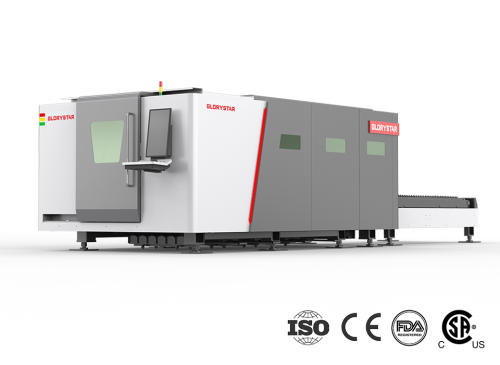
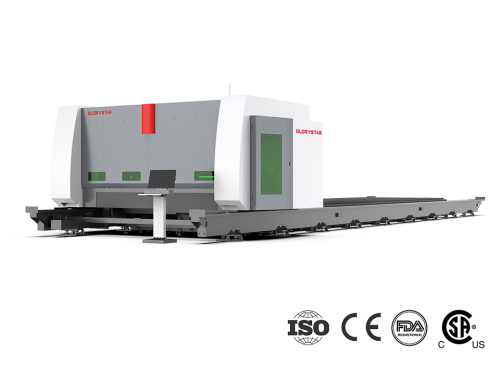
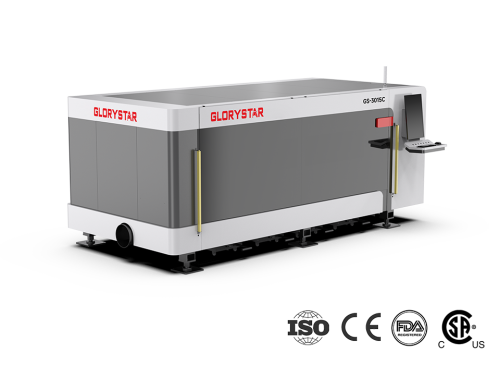
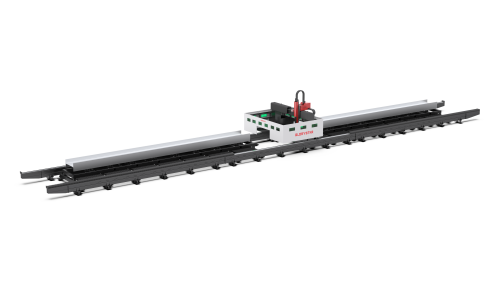
Modern gantry laser welding systems provide more than high-quality welding—they enable intelligent manufacturing.
An integrated solution typically includes:
Continuous fiber laser source
Oscillating welding head
Automated fixtures
Precision motion control
Vision positioning
Real-time process monitoring
Leak testing
Quality traceability
During welding, intelligent monitoring systems can detect defects such as pores or cracks immediately, allowing corrective action before defective products leave the production line.
Every welded component can also be recorded for complete manufacturing traceability.
Flexible Solutions for Different Manifold Designs
Every cooling system has unique design requirements.
A professional laser welding solution can be customized to support:
Thin-wall manifolds
Thick-wall manifolds
Multi-channel manifolds
Irregular geometries
Stainless steel
Aluminum alloys
Copper alloys
Different connector configurations
Manufacturers can also integrate laser welding directly into existing production lines or build dedicated automated welding workstations according to production capacity.
Applications Across Multiple Industries
Laser welded manifolds are now widely used in:
Electric vehicle battery cooling systems
Energy storage thermal management systems
AI server liquid cooling loops
Data center cooling infrastructure
Industrial equipment cooling systems
Process cooling pipelines
Electronics manufacturing
Aerospace applications
Defense manufacturing
As liquid cooling technologies continue expanding across industries, laser welding has become an essential enabling technology.
Conclusion
Modern cooling systems demand far more than simple mechanical connections. Manufacturers require manifolds capable of delivering exceptional leak tightness, dimensional accuracy, long-term durability, and consistent mass-production quality.
Compared with traditional welding methods, laser welding provides substantial advantages through micron-level precision, minimal thermal distortion, deep penetration capability, superior sealing performance, and intelligent automation.
For stainless steel manifolds used in industrial cooling, electric vehicles, energy storage, AI servers, and other advanced thermal management applications, laser welding is no longer simply an alternative manufacturing process—it is becoming the new industry standard.
By combining customized welding processes, automated production, intelligent quality monitoring, and nearly leak-free weld performance, modern gantry laser welding systems help manufacturers improve product reliability, increase production efficiency, and meet the demanding standards of next-generation liquid cooling technologies.