Across U.S. shipyards, investments in cutting equipment have continued to increase as managers look for ways to improve shipyard welding productivity and shorten project lead times. Faster machines, higher power levels, and improved automation all promise higher throughput. Yet many shipyard managers notice a frustrating reality: overall output does not improve as much as expected.
The reason is simple but often overlooked. In shipbuilding, shipyard welding productivity — not cutting speed — determines how fast a project truly moves forward. And in many cases, welding productivity is already being limited long before the first weld is made.
Welding Is the Most Constrained Resource in U.S. Shipyards
In American shipyards, welding is one of the most constrained and expensive production resources.
Skilled welders are increasingly difficult to recruit and retain. Labor costs continue to rise, and adding welding capacity is rarely as simple as buying more equipment. Welding workstations are tightly linked to safety regulations, floor layout, and project sequencing.
As a result, shipyard welding productivity has become the primary bottleneck in vessel construction. When welding slows down, block assembly stalls, downstream trades wait, and delivery schedules come under pressure.
For decision-makers, this means one thing: protecting welding capacity is no longer optional — it is a strategic priority.
From a management perspective, it is tempting to assume that faster cutting will naturally improve overall production. In reality, shipyards operate as tightly connected systems, not isolated processes.
Cutting departments may finish parts earlier, but if those parts are not immediately usable for welding and assembly, the gain disappears. Welders may be forced to wait, rework parts, or adjust fit-ups on the floor.
This mismatch creates hidden downtime — time that never shows up as machine stoppage, but still reduces shipyard welding productivity. Faster cutting alone does not solve system-level constraints.
How Cutting Quality Directly Impacts Welding Hours
Inconsistent Edge Conditions Increase Weld Preparation Time
When cut edges vary in condition, weld preparation becomes unpredictable. Some parts can move directly to welding, while others require grinding, edge correction, or additional beveling.
Each extra preparation step consumes welder time without adding value. Over weeks and months, these small inefficiencies accumulate into a significant loss of shipyard welding productivity.
Poor Fit-Up Disrupts Welding Rhythm
Fit-up quality plays a critical role in welding efficiency. Poorly aligned parts slow down the welding process, interrupt work rhythm, and increase the likelihood of defects.
Instead of focusing on continuous welding, operators spend time adjusting parts, clamping, and rechecking alignment. These interruptions reduce arc-on time — the key metric that defines real welding output.
Small Cutting Deviations Create Large Assembly Delays
Minor dimensional deviations introduced during cutting often go unnoticed until assembly. At that stage, the cost of correction increases dramatically.
What appears as a small cutting issue becomes an assembly delay, pulling welders away from planned work and further reducing shipyard welding productivity across the project.
Cutting as the First Gate of Welding Productivity
Welding productivity does not begin at the welding station. It begins much earlier, with the quality and usability of cut parts.
When cutting delivers parts that are consistent, well-aligned, and ready for welding, downstream processes flow naturally. When it does not, welding becomes reactive rather than planned.
From a management perspective, cutting should be viewed as the first quality gate for shipyard welding productivity, not just a material preparation step.
Why Shipyards Struggle to Predict Welding Capacity
Many shipyards struggle with accurate welding capacity planning. Schedules include buffers, contingency time, and manual adjustments — all symptoms of uncertainty.
In most cases, this uncertainty originates upstream. When the usability of cut parts varies, welding hours become difficult to forecast. Projects compensate by adding safety margins, which lowers overall utilization.
Improving predictability at the cutting stage helps stabilize welding schedules and improves long-term shipyard welding productivity.
Rethinking Laser Cutting from a Shipyard Management Perspective
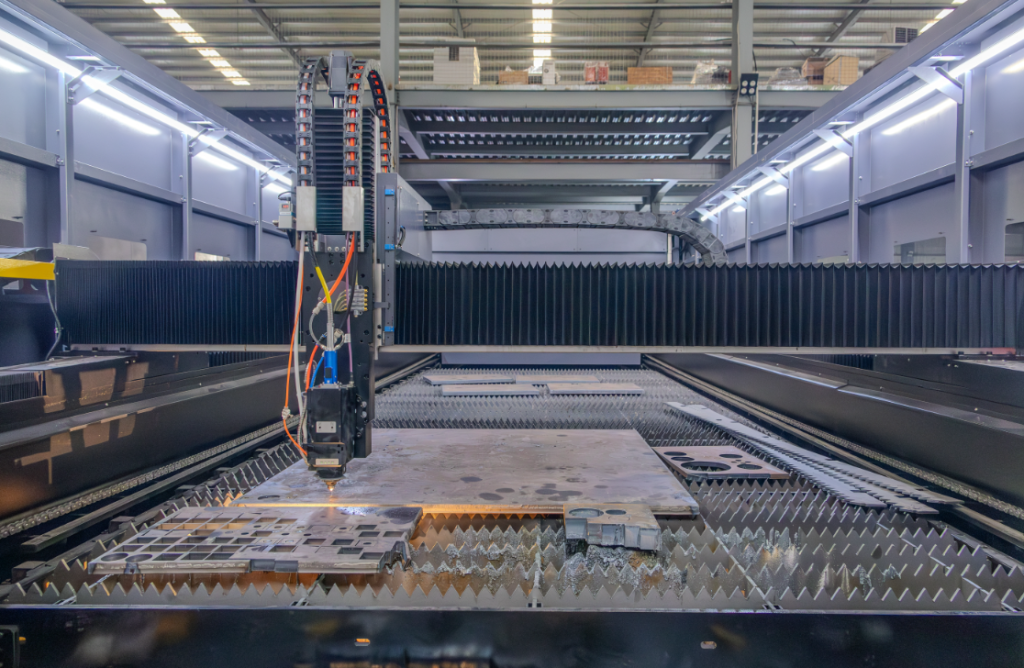
From a shipyard management standpoint, laser cutting should not be evaluated solely on speed or power level. Its real value lies in how it supports downstream productivity.
When cutting produces parts that minimize weld preparation, improve fit-up, and reduce corrective work, welding teams can focus on productive welding time rather than problem-solving.
In this context, laser cutting becomes a tool for protecting and expanding shipyard welding productivity, not just a faster way to process steel.
What Shipyard Decision-Makers Should Evaluate
When assessing cutting solutions, shipyard leaders should ask practical, outcome-driven questions:
Do cut parts require significant weld preparation?
Are welding hours consistent and predictable across shifts?
Does cutting quality support first-pass assembly?
Is welding time being consumed by issues that originate upstream?
The answers to these questions reveal whether cutting operations are supporting or limiting shipyard welding productivity.
Conclusion: From Cutting Speed to Welding Output
In shipbuilding, improving overall output rarely starts with welding equipment alone. It starts by ensuring that upstream processes consistently deliver parts that welders can use immediately and efficiently.
By shifting the focus from cutting speed to welding output, shipyards can unlock higher productivity, better schedule control, and more predictable project delivery.
Ultimately, protecting shipyard welding productivity means recognizing that the quality of every weld is shaped long before the welding arc is struck.